Ms. Chang, a.k.a. “The Master”: Making Croissants

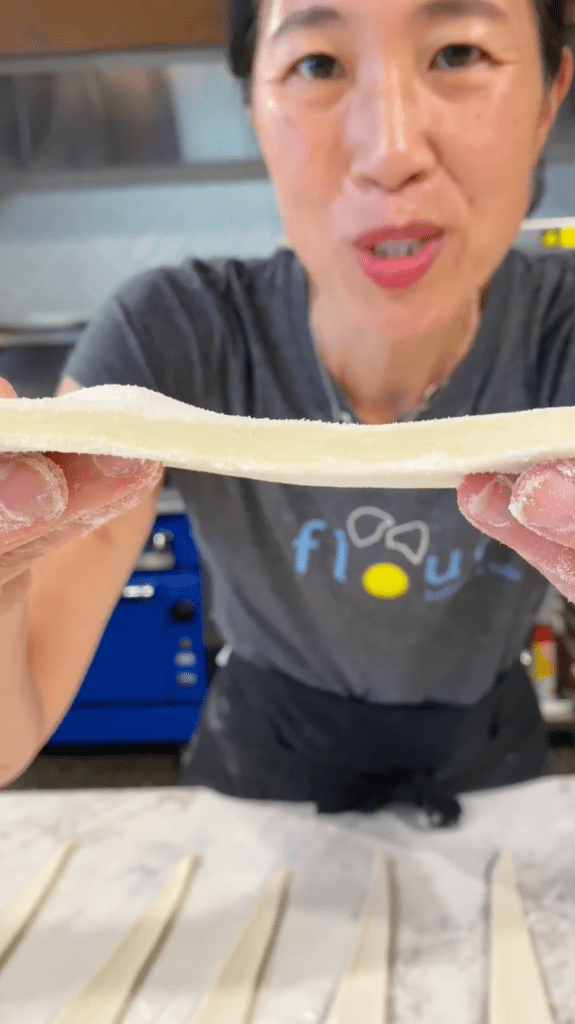
While perusing the Flour Bakery website, I found out that, during the lockdown stage of the pandemic, Joanne Chang produced a bake-at-home instagram series (look for the “Flour❤️ Wk#” videos on her instagram feed). Included in the weekly series was an episode on croissants, including her recipe! I found the series on her instagram account, and here is the video episode showing the wonderful Ms. Chang, herself, making beautiful croissants.

I have been following her recipe for croissants rather exclusively, but seeing her do it really helps to answer some questions I’ve had, and reassures me that I’m going in the right direction. It’s also comforting to know that the problems I have making these roll out into rectangles isn’t just me. (BTW, their secret: Just cut off the parts that make it not square!).

I’ve also been wondering alot lately about the final shaping and whether I’m forming mine correctly. I haven’t been getting the fat, round, super-puffy results that she gets, and I wondered whether it had to do with my technique. I also struggle with butter leakage during baking.

My conclusion from watching her video is that it isn’t about how I form the final croissant; it’s about how they rise. I haven’t figured out the best way to let the formed croissants rise to optimize loftiness without letting the butter get too soft. I’m thinking the answer is a cooler environment than I’ve been using, but for a much longer amount of time. She suggests a room temperature of 78°F for 2-2½ hours, but this hasn’t been working for me.

Maybe it’s my yeast, or the humidity level, or something. But, I suspect I’ll have better luck with a cooler rise for a longer period of time. I think that will be my next experiment, anyway.

One other minor thing to mention: The recipe on the website (on this page, search for “croissant”) differs slightly from the recipes in her first cookbook and in Pastry Love — this version uses a bit of cake flour (as opposed to a bit of bread flour, or a bit of spelt flour), and this version puts a bit of butter into the dough itself (Pasty Love doesn’t do this). I’m guessing none of these variations makes a big difference.

Also, Joanne Chang’s instagram account has wonderful pastry photos!

If you’re wondering what I’ve been baking lately, mostly just a rotation of my usual things… sourdough loaves, sourdough pita, and a mini-obsession with oatmeal-cherry cookies, which I’ll post about soon.
Croissants, Episode 3

So, I wanted to try the updated croissant recipe that I saw in Joanne Chang’s newer cookbook, Pastry Love. In my comparison chart I refer to this as “Chang 2”. Here are the differences that I saw:

  • The newer recipe is for “spelt croissants” so the flour content is half spelt flour and half bread flour. Her original recipe is 3/4 all-purpose flour and 1/4 bread flour, but the overall flour volume is nearly the same, as is the flour to liquid ratio. I wasn’t interested in trying the spelt variation, but it seemed safe to stick with the original all-purpose/bread flour approach from the original recipe.
  • The newer recipe eliminates the step of mixing 2T of butter into the dough itself. That 2T of butter gets added into the butter block, so it’s not removed overall. It just doesn’t have to mixed into the dough. I appreciated the idea of saving some work, so I went with this change
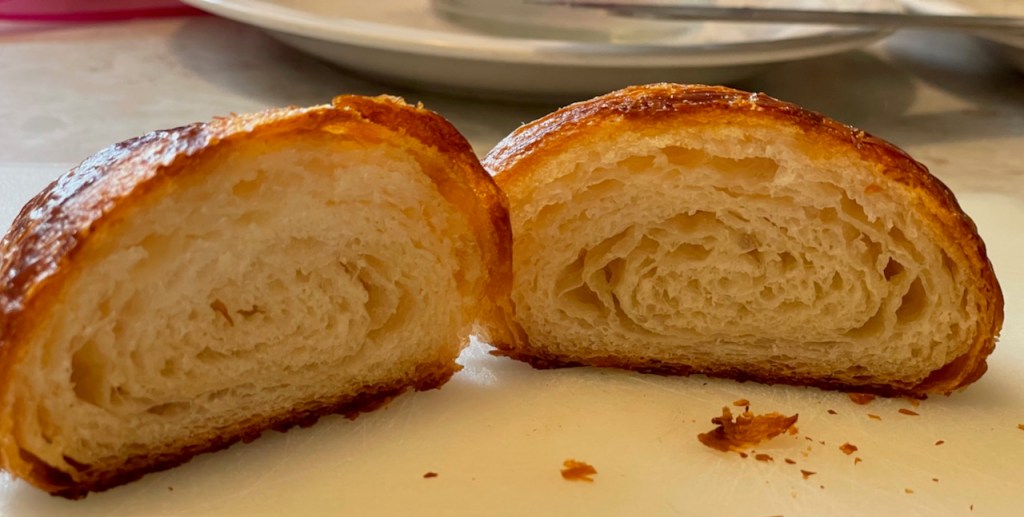
  • Her lamination method is notably updated. Rather than book-fold/letter-fold/chill/letter-fold, this recipe has only two book-folds and that’s it. No mid-lamination chilling! Because of my prior issues with the butter breaking up after being chilled mid-lamination, I am especially excited about this change. And, it reduces the overall duration of the effort (because it takes away one chill step and one fold step). We’re now down to 16 layers (having already gone from 729 -> 36), and I haven’t seen a deterioration in the flakiness of the end result.

I should note that Joanne’s newer lamination method isn’t a classic “book fold”. I think of it as a “modified book fold” and haven’t seen it described anywhere else. It is essentially the same, and still creates the four layers as a regular book fold. The only difference is that all the dough ends are not concentrated in the middle of the dough packet. She offsets the “seam” a bit, and I think this is another tweak that helps maintain the structural integrity of the desired rectangular shape. It’s hard to explain the difference without just sending you to her book (Pastry Love), which has very helpful instructions and photos.

I love the idea that Joanne Chang and her team at Flour Bakery are looking for ways to improve things – even very good things. The lamination method has nothing to do with the spelt change, so this seems to be entirely a process improvement.

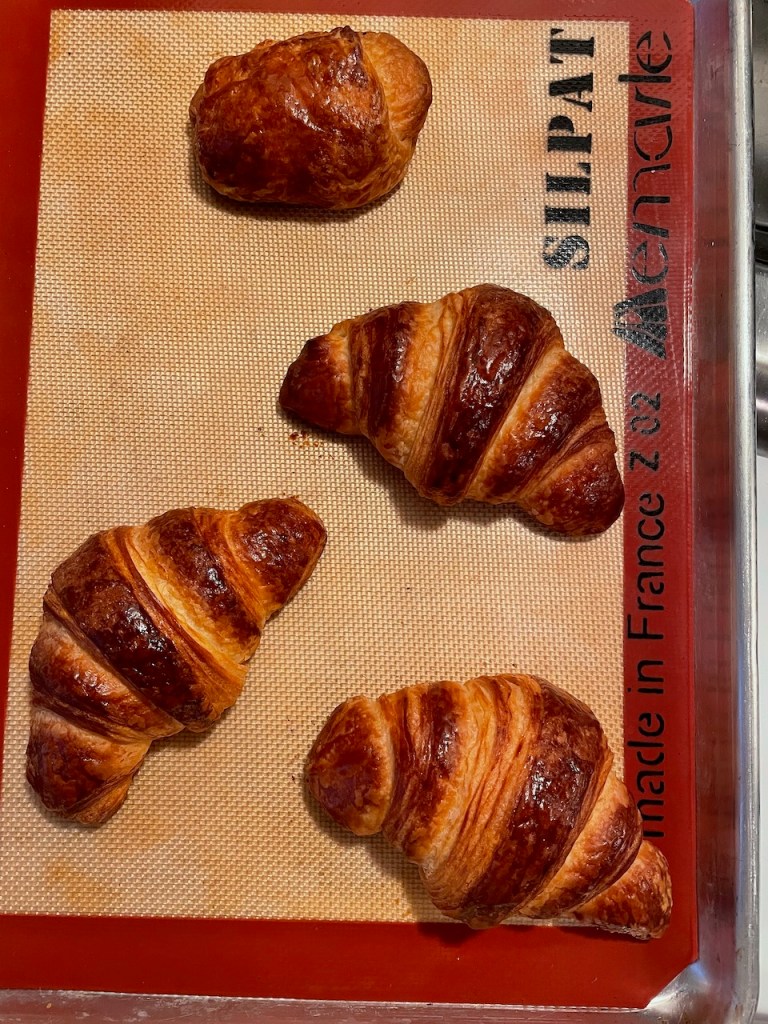
I think I haven’t explicitly mentioned that I make one Pain au Chocolat with each batch of croissants using any leftover bits of laminated dough. (You can see it in the first photo at the top of this post.) I mush the bits back together and roll them out into a rectangle, then roll up some dark chocolate batons and bake with the rest of the croissants. I have to say that these little treats, made from the “leftover bits”, have been such a delight that I think I will try to make more of an effort to allocate some proportion of the next batch to Pain au Chocolat – not just the scraps!