


Question: What do you get when you cross a croissant with a cinnamon roll?
Answer: A Morning Bun!
Other acceptable (also right) answers:
- A rather messier kitchen
- Contentedly pudgier than you were before
I tried an experiment last week with adding sugar and cinnamon to the Joanne Chang croissant butter block. This was successful in only one way: They tasted great. In every other way, they were a failure. It was basically impossible to contain the butter/sugar for the lamination turns, Stuff was bursting out all over the place. Also, the sugar massively leaked out during baking, so the croissants were basically stewing in syrup on the baking sheet. Not that this is necessarily a bad thing, but the croissants weren’t pretty, and they didn’t retain enough sugar to be the sweet treat I had imagined.
So then I googled “laminated cinnamon rolls” and found myself staring, mouth agape, at another Chad Robertson recipe (found via this article and shown in this video). His morning bun recipe is in their book “Tartine: A Classic Revisited“, which I found available as a Prime Reading title on Kindle (free for Prime members). I had not been familiar with the term “morning bun” before this, but apparently it’s “not a big thing on the East Coast.” Well, it should be!
I used Joanne’s croissant dough and then Chad’s morning bun recipe from there. The only other changes I made were:
- I didn’t have oranges to zest, so I put 1.5 teaspoons of Penzey’s orange extract in the filling. It’s amazing how nicely the orange flavor boosts these, even though it’s not evident that that’s what’s in there.
- Instead of tossing the cooled buns in sugar, I made a simple, non-cream-cheese glaze.
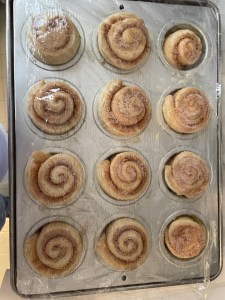
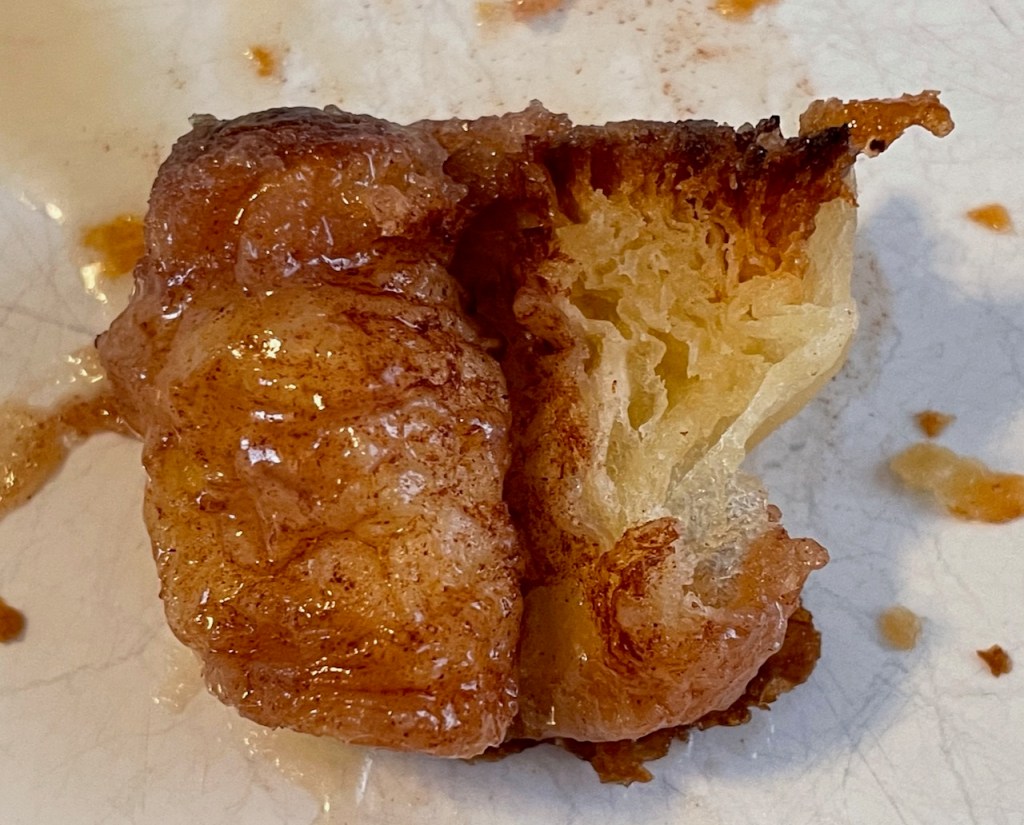
I need to note that after 35 minutes (well before the morning bun recipe’s 45 minute baking time) the tops were overdone and the bottoms weren’t quite done enough. Eating them, though, the textures felt right, so I wasn’t too far off the mark. I suspect that the bottoms didn’t brown as well because the muffin pan needed to be placed on a sheet pan to collect the anticipated overflow of butter, cinnamon, and sugar. Next time, I think it would help to shield the tops with a piece of loosely placed foil after maybe 15 minutes. Another possible step is to reduce the 400°F oven temperature to 375°F.
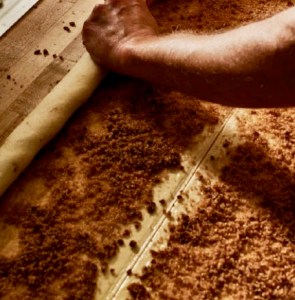
Another note is that in the video of Chad linked above and in the photo provided in the recipe itself (shown here), his filling looks totally different from the one I got from following the recipe. I checked it three times, and I’m reasonably sure that the recipe has an error. It says that the filling has only white sugar, cinnamon, and orange zest. No moisture. I substituted orange extract for the zest, but that wasn’t much moisture and the result was a pale brown sandy mixture. It was wonderful, but I noticed afterwards that the video and photo show a darker brown and lumpier mixture.
I think that the recipe omits stirring in melted butter and/or including some brown sugar. Melted butter is on the ingredient list, but is only called for as a brushed-on layer before spreading out the sugar/cinnamon filling. The large amount of melted butter is reasonable for spreading, as his croissant recipe yields a massive amount of dough (nearly 1,000g of flour compared with 410g in Joanne’s recipe) rolled out to a very large 1/4″ x 10″ x 32″ rectangle. But, I suspect that some of the listed melted butter amount was meant to be combined with the sugar and cinnamon. I did check for book errata and found one, but not this one.
So, next time I will put some melted butter into the filling until it looks like his photo.
 FlayRah